
Key Takeaway: The future of MSPs is not about the tools. It is about the leadership. The providers that will thrive are the ones that invest in strategic thinking, client relationships, and operational maturity, not the ones with the most integrations.
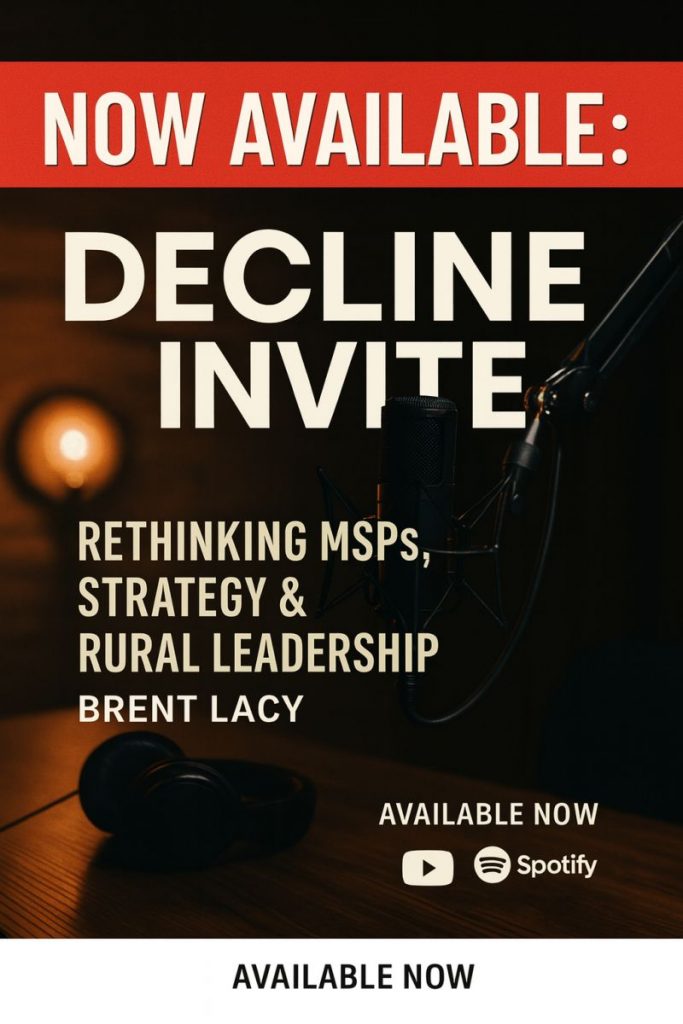
The market for Managed Service Providers (MSPs) is evolving faster than ever. To succeed, leaders must move beyond reactive IT support and embrace a new model centered on strategy, security, and client partnership. I recently had the privilege of discussing this transformation and more as a guest on the “Decline Invite” podcast.
In this episode, “Rethinking MSPs, Strategy & Rural Leadership,” we dive into the core principles that separate thriving MSPs from the rest. It was a fantastic conversation about actionable IT leadership and building a resilient, forward-thinking business.
Key Topics for MSP and Business Leaders
This podcast is packed with valuable insights for anyone in the IT space or any business leader looking to turn their technology into a competitive advantage.
We focused on several key areas:
- The Future of Managed Service Providers: We explore why the old break-fix model is obsolete and how MSPs can become true strategic advisors for their clients, focusing on long-term goals and business security.
- Strategy Before Scale: Growth is important, but a solid IT strategy is what delivers real value. We discuss how to build a strategic framework that guides your services, from quoting and billing to team leadership.
- The Power of Rural Leadership: My career has shown me that innovation isn’t limited to big-city tech hubs. We talk about how community-focused values and rural leadership principles can be a significant advantage, building trust and sustainable growth.
- From Cost Center to Competitive Edge: For business owners, we cover how to stop seeing IT as just an expense. A proactive IT strategy can secure your operations, streamline processes, and equip your team to succeed.
Listen to the Episode
This conversation connects directly to the core themes I write about: building a Rewired MSP, developing a vCIO mindset, and avoiding the “Near Miss” IT failures that threaten businesses.
If you are passionate about the future of IT leadership and want to build a business with lasting impact, this episode provides a clear roadmap.
- Watch on YouTube: Rethinking MSPs, Strategy & Rural Leadership
- Listen on Spotify: Decline Invite Podcast Episode
After you listen, explore my books to get the detailed frameworks and guides for implementing these strategies in your own MSP or business.
About the Author
Brent Lacy has spent nearly 30 years in the IT industry building and advising managed service providers. He is the author of Rewired MSP: Mastery, Scalability and Performance, vCIO Rewired: Virtually Conquering IT Obstacles, and Near Miss: Preventable IT Failures Threatening Your Business Security.
Related Articles
Frequently Asked Questions
What is the Decline Invite podcast?
Decline Invite is a podcast focused on IT strategy and leadership for managed service providers. It covers the business and leadership challenges that MSP owners face, including scaling, client relationships, team building, and the strategic decisions that determine whether an MSP builds lasting value or stays stuck in the owner-operator trap.
What topics does the podcast cover?
MSP business strategy, leadership development, client relationship management, technology advisory, and the operational disciplines that separate high-performing MSPs from average ones. The conversations are practical and direct, focused on what MSP owners can actually do rather than theoretical frameworks.
How can I apply podcast insights to my MSP?
Start with the episode most relevant to your current challenge. If you are stuck in the owner-hero trap, start there. If client retention is your problem, start there. The insights are most useful when applied to a specific situation rather than consumed as general knowledge.
What MSP Owners Can Take From This Conversation
The podcast format surfaces things that written content often misses. The hesitation before an answer. The moment when a guest realizes mid-sentence that they have been thinking about something the wrong way. The specific example that makes an abstract principle concrete. These are the moments that make a conversation worth having and worth listening to.
The themes that come up repeatedly in conversations about MSP leadership are not surprising, but they are worth naming because they are easy to know and hard to do. Owner dependency is the most common ceiling. Documentation is the most common gap. Client trust is the most common differentiator. And the willingness to have difficult conversations, with clients, with employees, and with yourself, is the most common predictor of whether an MSP builds something lasting or stays stuck.
The MSP owner who listens to these conversations and recognizes their own situation in them has already done the hardest part: seeing the problem clearly. The next step is deciding what to do about it.
Why Leadership Conversations Matter for MSPs
Technical competence is the entry requirement for running an MSP. It is not the differentiator. The MSPs that build lasting businesses are led by people who understand that the technical work is in service of a business outcome, and that the business outcome is in service of a client relationship, and that the client relationship is built on trust that takes years to earn and moments to lose.
Leadership conversations, whether in a podcast format or a peer group or a one-on-one with a mentor, are where MSP owners develop the perspective that technical training does not provide. The ability to see your business from the outside. The ability to recognize patterns that are invisible when you are inside them. The ability to make decisions that serve the long-term health of the business rather than the short-term comfort of avoiding a difficult conversation.
That perspective is what separates the MSP that is still growing in year ten from the one that is still fighting the same problems it had in year two.
This article is part of the vCIO Services hub.
