
Key Takeaway: MSP growth does not require a sales guy. It requires three distinct functions: someone who generates opportunities, someone who closes them, and someone who grows and retains existing accounts. Confusing the roles is how MSPs end up with a sales problem that looks like a people problem.
For many MSP owners, the moment comes when they realize they can’t do it all. They’ve built a great service, they have happy clients, but the business has hit a growth ceiling. The next logical step seems obvious: “We need to hire a sales guy.”
But this is one of the most common and costly mistakes a growing MSP can make.
The problem is that “sales” isn’t a single job. It’s a combination of distinct skills, mindsets, and temperaments. Hiring one person and expecting them to generate leads, nurture them, close deals, and manage relationships is a recipe for burnout and a stalled pipeline.
A sustainable MSP growth engine isn’t built on a single “sales guy.” It’s built by understanding and filling unique and essential roles.
The Sales vs. Marketing Trap
Before we even get into sales roles, let’s clear up a huge point of confusion: Sales and Marketing are two different disciplines.
- Marketing is the art and science of attracting attention and generating interest. It’s about building your brand, creating valuable content, and running campaigns that bring potential clients to your door. Marketing creates the opportunity.
- Sales is the process of converting that opportunity into a client. It involves discovery calls, building relationships, presenting solutions, and closing the deal.
Your first hire is not going to be an expert at both. Asking one person to be a brilliant digital marketer, a creative content writer, and a relentless sales prospector is unrealistic. Unless you’ve found a unicorn, you’re hiring for one skill set or the other. When you hire a “sales guy,” you are hiring someone to sell, not to build the entire lead generation machine from scratch.
The Founder’s Advantage Can’t Be Delegated
Here’s another hard truth: when you hire your first salesperson, you cannot simply hand them your playbook and expect the same results. As the founder, you have an inherent advantage that a new hire doesn’t.
In the SMB space, many of your prospects are owners themselves. They want to talk owner-to-owner. A business owner who would make time for you might not make time for a “hired hand.” This is why, as you transition sales away from yourself, the process has to change. It needs to be more structured and less reliant on the founder’s personal charisma to open doors. This is a critical pivot discussed in detail in Chapter 9 of Rewired MSP.
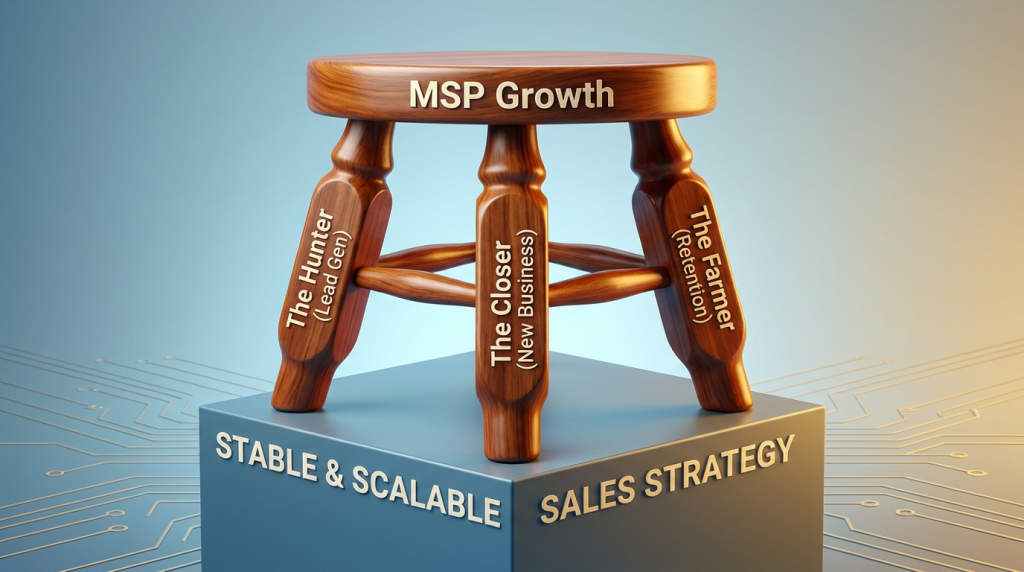
The Three Pillars of a High-Performing MSP Sales Team
To build a sales process that actually scales, you need to build a team of specialists. As outlined in Chapter 8 of Rewired MSP, these roles are the Hunter, the Closer, and the Farmer.
1. The Hunter (The Lead Generator)
Common Titles: Sales Development Representative (SDR), Lead Generation Specialist
The Hunter is your prospector. This person is relentless, creative, and motivated by the thrill of the chase. Their entire focus is on one thing: filling the top of your sales funnel. They are experts at cold outreach, networking, and turning a “no” into a “tell me more.”
- What they do: Identify and engage new prospects, book initial meetings, and qualify interest.
- Why you need them: Without a Hunter, your pipeline has no starting point. A closer with no leads to close is just waiting by the phone.
2. The Closer (The Deal Maker)
Common Titles: Account Executive, Business Development Manager
The Closer takes the warm lead from the Hunter and guides it through the sales process to a successful close. This person excels at discovery, solution design, and demonstrating value. They are comfortable talking business outcomes with executives and navigating the negotiation process. Hubspot calls this role “the trapper”.
- What they do: Conduct discovery meetings, present solutions, handle objections, and finalize contracts.
- Why you need them: The Closer transforms a prospect’s interest into tangible revenue. They are the architects of the new client relationship.
3. The Farmer (and the vCIO Landmine)
Common Titles: Account Manager, Client Success Manager, vCIO* (but it may not be the best call...)
The Farmer’s role is to nurture the long-term health of the client relationship, driving retention and identifying natural opportunities for growth.
*This is where many MSPs merge the role with the virtual CIO (vCIO), creating an inherent conflict of interest. As I detail in Rewired MSP and vCIO Rewired, a vCIO with a financial incentive to upsell loses their impartiality. In a rewired MSP, the Farmer is a sales function focused on relationship management. The vCIO is a purely strategic, advisory role. This separation is vital for building lasting trust.
- What the Farmer does: Ensures clients are happy, uncovers natural upsell/cross-sell opportunities, and manages contract renewals.
- Why you need them: The Farmer protects your revenue base and maximizes client lifetime value, but must work alongside an impartial vCIO, not as the vCIO.
But I Can’t Afford All Three. What Now?
This is the reality for most growing MSPs. The good news is you don’t need to hire all three at once. Your growth strategy should be sequential, based on solving your biggest bottleneck first.
As the business owner, you are almost certainly the primary Closer. You excel at building trust and getting deals signed. You may also be the primary Farmer, managing key relationships.
Therefore, your most significant bottleneck is the lack of new, qualified opportunities. Your first hire should be a Hunter.
By hiring a dedicated Hunter (SDR), you create a consistent flow of leads for you, the Closer, to convert into new business. This immediately addresses your most pressing growth problem and provides the highest return on your first sales investment. As revenue grows, you can then hire a dedicated Closer, freeing you up to finally step back and lead the business.
Build Your Team and Your Playbook
Building a high-performing sales team is about more than just hiring people; it’s about creating a scalable, ethical, and client-focused growth engine. The structure of your sales team, the separation of sales and marketing, and the unbiased nature of your strategic advice are all cornerstones of a business built to last.
To learn the detailed frameworks for structuring these roles, avoiding common pitfalls, and building a truly “Rewired” organization, get your copy of the book.
[Click Here to Get “Rewired MSP” and Build Your Growth Engine the Right Way]
Related Articles
- Your New Sales Hire Will Fail Without This
- How to Scale Your MSP: From Owner-Hero to Visionary Leader
- Is Your MSP Built to Last, or Just Built to Bill?
About the Author
Brent Lacy has spent nearly 30 years in the IT industry building and advising managed service providers. He is the author of Rewired MSP: Mastery, Scalability and Performance, vCIO Rewired: Virtually Conquering IT Obstacles, and Near Miss: Preventable IT Failures Threatening Your Business Security.
This article is part of the MSP Growth and Sales Hub, everything Rewired MSP has published on building a scalable MSP practice.
Frequently Asked Questions
What are the three sales roles an MSP needs?
Hunter, Closer, and Farmer. The Hunter finds and qualifies new opportunities. The Closer converts qualified opportunities into signed agreements. The Farmer manages and grows existing client relationships. These are different skills that rarely exist in the same person at the same level of competence.
Can one person fill all three sales roles?
In the early stages of an MSP, yes, out of necessity. As the business grows, the owner who is doing all three roles is the bottleneck. The first sales hire should address the role where the owner is weakest or where the business has the most opportunity. For most MSPs, that is the Hunter role.
What is the most common MSP sales mistake?
Hiring a salesperson and expecting them to build the sales process from scratch. The salesperson needs a defined process, qualified leads, and a service delivery team that can fulfill what they sell. A salesperson without these things will either fail or succeed by making promises the business cannot keep.

One Comment