
Key Takeaway: Avoiding an IT contract feels like flexibility. It is actually a transfer of risk from the provider to the client. A good IT contract protects both parties. And the MSPs worth working with are willing to sign one.
I hear it all the time from business owners: “I don’t want to be locked into a contract.” It sounds like a smart business decision. You want flexibility. You want to control costs. You don’t want to be stuck paying for services you might not need.
I understand that thinking. But here is what I have learned after nearly 30 years in the IT industry: when it comes to your business’s technology and data security, avoiding an IT contract is not protecting you. It is exposing you to massive hidden costs and vulnerabilities that could cripple your business.
As I explore throughout my book, Near Miss, the reluctance to commit to a structured IT agreement creates a culture of reactive firefighting, undocumented systems, and misaligned incentives that leave your business data at serious risk. Let me walk you through why this mindset is dangerous and how the right IT contract can actually be one of the best investments you make.
In this article
- You Already Have Contracts for Things That Matter Less
- The IT Industry Has Changed
- The Illusion of Flexibility
- What a Good IT Contract Actually Provides
- But What If I Pick the Wrong Provider?
- The Real Risk Is Staying “Flexible”
- Frequently Asked Questions
You Already Have Contracts for Things That Matter Less
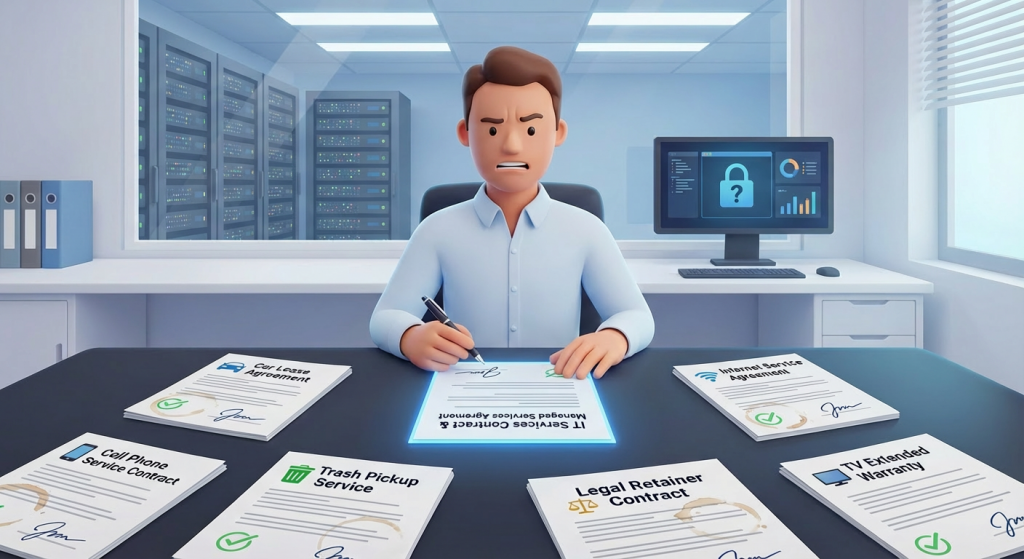
Think about your business and personal life for a moment. How many contracts do you currently have in place?
You probably have a lease or financing agreement for your company vehicles. You might have a retainer agreement with your attorney for legal services. Your business has a contract for trash pickup. You have service agreements for your cell phones and internet connectivity. You might even have an extended warranty on that really nice TV you bought for your home.
These are all things you have decided are important enough to commit to with a contract. Yet, many of these services are relatively inconsequential when compared to the security and continuity of your business’s critical data and operations.
Managing the security of your IT infrastructure and critical business data should be in this same category, without a second thought. If you are willing to sign a multi-year lease on a vehicle or commit to a cell phone plan, why would you hesitate to formalize an agreement with the team responsible for protecting your most valuable business asset: your data?
The IT Industry Has Changed
The IT support industry has evolved dramatically over the last 10 to 20 years. The quality and competence of IT providers willing to work on a non-contract, hourly basis is simply not what it once was.
In the past, you could find skilled, reliable technicians who operated on an “as needed” model and delivered solid results. Today, the market has fundamentally shifted. The best providers have moved to structured, contract-based managed services models because it allows them to implement the business systems, tools, and proactive processes required to deliver enterprise-grade security and support.
Providers who remain in the break-fix, no-contract space often do so because they lack the infrastructure, expertise, or commitment to build a true managed services practice. The market has pushed competent providers toward predictable, recurring revenue models because that is what allows them to invest in the monitoring tools, security platforms, documentation systems, and skilled staff that modern businesses require.
If a provider is unwilling or unable to commit to a service agreement, it is worth asking why. Are they uncertain about their ability to deliver consistent value? Do they lack the tools to proactively manage your environment? Or are they simply profiting more from your problems than from your success?
The Illusion of Flexibility
When you operate without an IT contract, you might feel like you have maximum flexibility. You can call someone when you need help and only pay for what you use. You are not “locked in” to anything.
But what does this flexibility actually cost you?
1. You Pay More in the Long Run
Without a contract, your IT provider is operating on an hourly, break-fix model. As I explain in Chapter 4 of Near Miss, this means they only make money when something goes wrong. Their business model is inherently reactive. They have no financial incentive to prevent problems or think strategically about your infrastructure. They profit from your downtime, not your uptime.
Every time something breaks, you get an invoice. Every hour spent troubleshooting is billable. Every component they need to order comes with a markup. The “flexible” approach of paying as you go almost always results in higher total costs than a flat-fee managed service agreement.
2. Nothing Is Documented
In Chapter 2, I stress that you are only as good as your documentation. But here is the reality: if your IT provider is not contractually obligated to maintain documentation, they will not do it. Why would they? It takes time, and if they are billing hourly, you likely will not want to pay them to write things down.
The result? Critical information about your network, passwords, configurations, and procedures exists only in one person’s head. When that person is unavailable, on vacation, or leaves for another job, your business is left scrambling. This is a massive, hidden risk that many business owners do not realize they have created until it is too late.
3. Your Security Suffers
Proactive security requires ongoing monitoring, regular updates, and strategic planning. It requires tools that need to be maintained, licenses that need to be renewed, and policies that need to be enforced. None of this happens in a break-fix, no-contract model.
Without a contract, your provider is not watching your firewall (Chapter 6), monitoring your network for unauthorized devices (Chapter 5), or ensuring your backups are tested (Chapter 8). They are simply waiting for you to call when something is already broken. By then, it is too late.
What a Good IT Contract Actually Provides
The right IT contract is not about locking you in. It is about creating alignment between your goals and your IT provider’s incentives. Here is what a well-structured managed services agreement should deliver:
1. Predictable, Flat-Fee Pricing
With a flat monthly fee based on the number of users, devices, or locations, you know exactly what your IT costs will be. There are no surprise invoices. No back-and-forth about how many hours were actually needed. No disputes over line items.
This transparency allows you to budget accurately and focus your energy on growing your business, not managing IT invoices.
2. Proactive Maintenance and Monitoring
A contract-based Managed Service Provider (MSP) is paid to keep your systems running smoothly. Their success is measured by your uptime, not your downtime. This fundamentally changes the relationship. They are incentivized to prevent problems, not profit from them.
This includes automated patching, 24/7 monitoring, regular security updates, and strategic planning to keep your infrastructure aligned with your business goals.
3. Complete Documentation
A competent MSP includes documentation as part of their service. They maintain a secure repository of your network configurations, passwords, vendor contacts, and procedures. This ensures that your business is not dependent on any single person and that transitions (whether planned or unplanned) happen smoothly.
4. Business Continuity and Disaster Recovery
As I discuss in Chapter 8, there is a critical difference between having a backup and having a business continuity plan. A good IT contract includes regular testing of backups, a clear Recovery Time Objective (RTO), and a documented plan for how your business will continue operating during a crisis.
Without a contract, you are simply hoping your backups work. With a contract, you have proof.
5. Strategic IT Planning
Perhaps most importantly, a true IT partner does not just keep the lights on. They help you build a technology roadmap that aligns with your business goals. They advise you on when to upgrade equipment, how to scale your infrastructure, and which tools will give you a competitive advantage.
This strategic guidance is never included in a break-fix, hourly billing model. It only happens when your provider is invested in your long-term success.
But What If I Pick the Wrong Provider?
This is the real fear, is it not? You are worried about being stuck with a provider who does not deliver or who takes advantage of you. That is a legitimate concern.
Here is how to protect yourself:
Read the Contract Carefully
Make sure you understand the terms. What is included? What costs extra? How long is the initial commitment? What are the terms for ending the agreement? A good provider will be transparent and willing to explain every detail.
Start with a Shorter Term
Many MSPs offer initial agreements of 12 months or even month-to-month for the first period. This gives you time to evaluate the relationship without a long-term commitment.
Look for Accountability Measures
The contract should include clear Service Level Agreements (SLAs) that define response times and resolution expectations. If the provider fails to meet these standards, there should be consequences. This protects you.
Check References and Reviews
A reputable provider will have a track record of long-term client relationships. Ask for references. Look at online reviews. Talk to other business owners in your industry. Do your homework.
The Real Risk Is Staying “Flexible”
The biggest risk you face is not signing the wrong contract. The biggest risk is continuing to operate without one.
Every day you delay, your business is exposed to:
- Unmonitored security vulnerabilities
- Undocumented critical systems
- Reactive, expensive firefighting
- No clear plan for business continuity
These are the hidden costs that do not show up on an invoice but show up when disaster strikes.
The right IT contract is not an expense. It is an investment in your business’s security, productivity, and long-term success. Stop thinking of IT as a cost center and start thinking of it as a force multiplier that drives growth.
Frequently Asked Questions
Q: What if I only have a small team? Do I really need an IT contract?
A: Absolutely. Small businesses are increasingly targeted by cybercriminals precisely because they often lack the structured security that comes with managed services. A good MSP can provide enterprise-level protection at a fraction of the cost of hiring an internal IT person.
Q: Can I negotiate the terms of an IT contract?
A: Yes. Reputable providers are often willing to customize agreements based on your specific needs, business size, and budget. Do not be afraid to ask questions and request modifications.
Q: What is the difference between a managed services agreement and a break-fix contract?
A: A break-fix contract bills you hourly when things go wrong. A managed services agreement charges a flat monthly fee and focuses on preventing problems. The incentives are fundamentally different.
Q: How do I know if my current provider is doing a good job if I do not have a contract?
A: Without a contract, there are no defined service levels, no accountability measures, and often no documentation of what has been done. Use the questions at the end of each chapter in Near Miss to start evaluating your current situation.
Q: What happens if I want to end the contract early?
A: This depends on the terms you negotiate. Many agreements allow for early termination with 30-60 days’ notice. Some may have an early termination fee. Always clarify this before signing.
Q: Will a contract force me to use tools or services I do not need?
A: A good provider will conduct an assessment and build a service package tailored to your actual needs. Beware of providers who try to upsell unnecessary products. The right partner focuses on what truly protects and gives your business.
Q: How much should I expect to pay for a managed services agreement?
A: Pricing varies based on the number of users, devices, and the level of service required. A common range is $100-$200 per user per month, but this can vary. Remember, this is a complete service that includes monitoring, security, support, and strategic planning.
This post is adapted from core themes in the book Near Miss: Preventable IT Failures Threatening Your Business Security. Get your copy to learn how to evaluate your IT environment and build a partnership that truly protects your business.
Related Articles
- 5 Signs of a Competent IT Provider (And How to Spot the Red Flags)
- The Grocery Store Mistake: Why Price Shopping for IT Support Is Dangerous
- The Break-Fix IT Myth: Why ‘Fix It When It Breaks’ Is Costing You Money
About the Author
Brent Lacy has spent nearly 30 years in the IT industry building and advising managed service providers. He is the author of Rewired MSP: Mastery, Scalability and Performance, vCIO Rewired: Virtually Conquering IT Obstacles, and Near Miss: Preventable IT Failures Threatening Your Business Security.
