
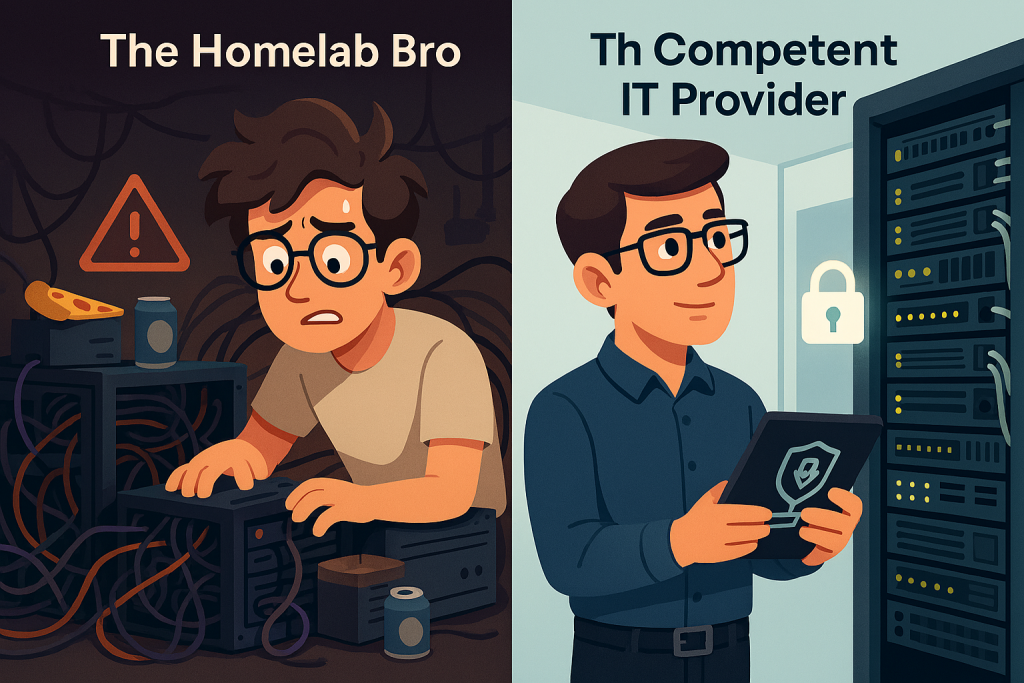
Every office seems to have one. The “Homelab Bro.” The “computer guy.” The well-meaning employee who is great with technology, builds their own PCs at home, and can always figure out why the printer isn’t working. In an effort to save money or solve a problem quickly, it’s tempting to lean on this person for your company’s IT needs.
This is a critical mistake. While their enthusiasm is valuable, a hobbyist’s approach to technology is fundamentally different from the disciplined strategy required to manage a professional business environment. As I stress throughout my book, Near Miss, relying on an internal “power user” can inadvertently create massive security risks, compliance gaps, and threats to your business continuity.
A car enthusiast who changes their own oil is not the same as a certified mechanic you’d trust with a fleet of commercial vehicles. The same logic applies to your IT.
The Hobbyist Mindset vs. The Professional Strategy
The “Homelab Bro” is driven by experimentation and personal interest. Their home lab is a playground for trying new things, often without the constraints of a real-world business environment. This mindset, when applied to your company, leads to significant problems.
- Experimentation over Stability: A hobbyist loves to tinker. A professional IT provider values stability, reliability, and predictability. Your business network should not be a testing ground for the latest beta software or an unvetted open-source tool. It needs to be a stable platform that works every time.
- Speed over Security: When an employee needs a problem solved now, the go-to tech person will often grant them administrative rights to their computer. This “solves” the immediate issue but creates a huge security hole. As discussed in Chapter 7 of Near Miss, this practice of granting excessive permissions is one of the fastest ways to let malware spread across your entire network. A competent provider implements the principle of “least privilege” to protect the whole organization.
- Undocumented “Fixes”: The quick fix applied by your internal expert is rarely documented. As detailed in Chapter 2, this creates a massive knowledge gap. When that employee is on vacation, sick, or eventually leaves the company, all that critical operational knowledge walks out the door with them, leaving your business incredibly fragile.
The Dangers of Shadow IT and the “Cheaper” Solution
When employees feel their IT needs aren’t being met, they turn to their internal tech expert, who then installs unapproved software or creates workarounds. This is “Shadow IT,” and it’s a security nightmare. Unsanctioned tools, especially free AI platforms, can leak your proprietary data and create compliance issues you will not discover until it is too late.
Many business owners justify this approach by thinking, “I found someone cheaper.” As I explain in Chapter 4 of my book, relying on an untrained person or the lowest-cost hourly provider is not a cost-saving measure. It is a gamble.
The real costs are not on an invoice. They are paid through:
- Downtime when an undocumented system fails.
- Data breaches from unpatched software and excessive user rights.
- Lost productivity as employees fight with unreliable systems.
- Compliance fines when unvetted tools violate regulations like HIPAA or GDPR.
What a Competent IT Provider Delivers
A true IT partner does not just fix things when they break. They bring a strategic, business-first approach that a hobbyist cannot provide.
A competent Managed Service Provider (MSP) is responsible for:
- Building a Strategic Roadmap: They align your technology with your business goals, ensuring it supports growth instead of holding you back.
- Enforcing Security and Compliance: They implement and manage security tools, user permissions, and policies to protect your business and its data.
- Maintaining Comprehensive Documentation: They create a repository of knowledge so that your business operations are not dependent on any single person.
- Providing Visibility and Proactive Maintenance: They monitor your network for threats and address issues before they become a crisis.
Your business deserves more than a well-meaning amateur. It needs a professional strategy. While you can appreciate your employee’s technical skills, their role is not to manage the security and continuity of your entire organization. That responsibility requires a dedicated, competent IT provider who understands that in business, there is no room for a “near miss.”
This post is adapted from core themes in the book Near Miss: Preventable IT Failures Threatening Your Business Security. Get your copy to learn the difference between a reactive hobbyist and a proactive IT partner.
