
In the world of business, some ideas feel comfortable because they are familiar. One of the most persistent is the concept of the “IT guy down the hall.”
It’s a perception based on an older idea of work: a single head office where, if your computer acted up, you could just walk down the hall, tap a person on the shoulder, and they would drop everything to come fix your issue. It sounds wonderfully responsive and personal.
In reality, this model is a perception fallacy. As I explore throughout my book, Near Miss, relying on this outdated structure is a massive drain on productivity and creates significant business risks that are hiding in plain sight. It is time to bust this myth.
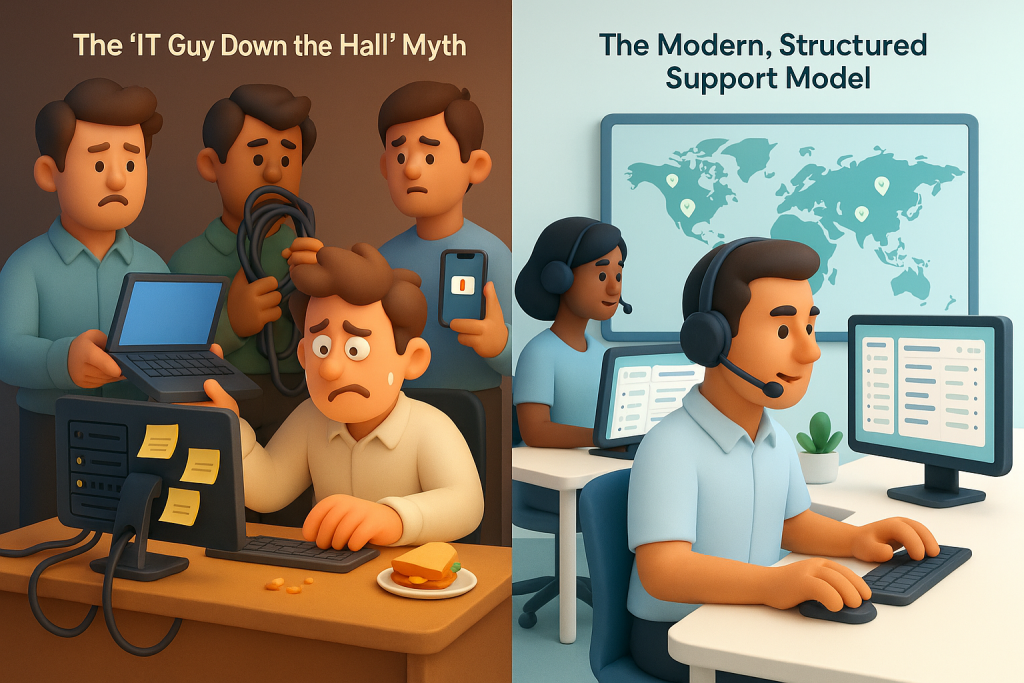
Why the “Walk-Up” Model Doesn’t Work
The idea of instant, personal support is appealing, but let’s look at what is actually happening when you have a single “IT guy down the hall.“
1. The Constant Interruption Tax
Every time an employee walks down the hall with a “quick question,” the IT person is forced to stop what they are doing. This context switching is incredibly inefficient. That person may have been in the middle of a critical server patch, a complex security configuration, or documenting a vital procedure.
As I cover in Chapter 4 of Near Miss, this model forces your most technical resource into a constant state of reactive firefighting. Strategic, proactive work that prevents future problems is impossible when the day is consumed by a series of unplanned interruptions.
2. The Productivity Hit for Everyone
The cost is not just on the IT person. The employee with the problem has to stop their work, get up from their desk, walk down the hall, and wait for the IT person to be available. What if the IT person is already helping someone else? Now you have two or more employees who are not being productive. A structured help desk system, by contrast, allows the employee to log a ticket and get back to other tasks while the issue is triaged and assigned.
3. It Simply Does Not Scale
This model breaks down completely in a modern business. What happens when you open a second office? What about your hybrid and fully remote employees? The “down the hall” approach offers them no consistent support. A single person can only be in one place at one time. As your team becomes geographically dispersed, this single point of failure becomes a bottleneck that slows the entire company down and creates support inequality between onsite and remote staff.
4. The “Hero” Becomes a Single Point of Failure
When one person holds all the keys, your business is incredibly fragile. As discussed in Chapter 2, if this person is busy, on vacation, sick, or leaves the company, their undocumented knowledge of quick fixes and unique configurations walks out the door with them. This creates a massive operational risk. A professional IT team, on the other hand, uses shared documentation and ticketing systems to ensure knowledge is retained by the organization, not just one individual.
The Modern Solution: A Structured Support System
A competent Managed Service Provider (MSP) or a well-run internal IT department replaces this chaotic, ad-hoc model with a structured and efficient system that serves everyone equally, regardless of location.
- Triage and Prioritization: A help desk system allows issues to be logged, categorized, and prioritized. A printing issue does not get the same immediate attention as a server outage affecting the entire company. This ensures critical problems are addressed first.
- Efficiency Through Specialization: In a team environment, tasks can be assigned to the person best suited to handle them. This is more efficient than having one generalist try to do everything.
- Proactive vs. Reactive: By managing interruptions through a ticketing system, the IT team has dedicated time for proactive maintenance, security monitoring, and strategic planning. They can prevent fires instead of just putting them out.
- Data and Analytics: A ticketing system provides valuable data. You can see recurring problems, identify training needs, or spot aging hardware that needs replacement. The “guy down the hall” model provides zero data for making strategic decisions.
The perception of the friendly, always-available IT guy is a nostalgic fallacy. It represents a model that is inefficient, unscalable, and risky for any modern business. True productivity and security come from a structured, professional approach that values proactive strategy over reactive chaos. Don’t let your business suffer a “near miss” by clinging to an outdated idea of support.
Frequently Asked Questions
Q: Isn’t an in-house IT person more dedicated to my company?
A: While they may be dedicated, their effectiveness is limited by the reactive model they are forced into. A professional IT team, whether in-house or outsourced, shows its dedication through proactive strategy, robust security, and measurable performance that a single, constantly interrupted person cannot provide.
Q: Can’t our “IT guy” just use a ticketing system?
A: They can, and it would be an improvement. However, this does not solve the core issues of being a single point of failure, the lack of scalability for multiple locations or remote workers, and the absence of a collaborative team for complex problem-solving and shared documentation.
Q: We are a small business. Isn’t a full IT team overkill?
A: Not at all. This is exactly the problem that a good Managed Service Provider (MSP) solves. For a predictable monthly fee, you get access to an entire team of experts, including a help desk, security specialists, and strategic advisors. Many times, this is a fraction of the cost of hiring a single, full-time IT person. This gives you the scale and expertise you need, when you need it.
This post is adapted from core themes in the book Near Miss: Preventable IT Failures Threatening Your Business Security. Get your copy to learn how to move from a reactive, outdated IT model to a proactive, modern strategy.
