
It’s a question every MSP owner has heard. You have spent weeks planning a critical server migration, a security overhaul, or a cloud transition. You have accounted for every license, every piece of hardware, and every hour of your team’s expert labor. You present the proposal, and the client’s eyes go straight to the bottom line.
Then comes the question: “Why does this project cost so much?”
If your first instinct is to defend the price by listing the parts and the hourly rates, you are having the wrong conversation. Your client is not just buying hardware or a block of time.
They are buying an outcome, certainty, and peace of mind.
A project is not just a bill you send; it is a promise you make. The cost reflects not only the work itself but the professional discipline required to deliver that work predictably, securely, and with minimal disruption to their business. Your job is to make that invisible value visible.
Defining the Win: The Power of a Clear Outcome
Before a single dollar is quoted, you have to take the most important step and define what success looks like. You have to do it in the client’s terms. A project’s “win” isn’t just a successful server install; it’s what that server enables.
- Does it mean their remote team can access files 50% faster, improving productivity?
- Does it mean their business is now compliant with a new industry regulation, avoiding hefty fines?
- Does it mean their critical data is now securely backed up, protecting them from a ransomware disaster?
As I emphasize in Chapter 7 of Rewired MSP, when you anchor the project to a tangible business outcome, the conversation shifts. The cost is no longer an arbitrary number but a strategic investment measured against a clear return. This shared understanding of the “win” becomes your north star throughout the entire project.
Preventing Scope Creep with a Rock-Solid Plan
Once the outcome is clear, the next step is to build a fortress against scope creep. Scope creep, the slow, insidious addition of “just one more thing” is a primary killer of project profitability and client trust. The antidote is a meticulously documented project plan.
This plan is your contract of clarity. It must transparently outline:
- What is IN scope: A detailed list of all deliverables, tasks, and objectives.
- What is OUT of scope: Explicitly stating what is not included prevents future misunderstandings. For example, “This project includes migrating email to Microsoft 365, but does not include user training on the new platform.”
- A Clear Change Order Process: Define upfront how new requests will be handled, quoted, and approved. This ensures that when the scope changes, the budget and timeline are adjusted formally, not just absorbed.
This isn’t about being rigid; it’s about being professional. A clear scope protects both you and the client from the frustration of mismatched expectations.
The Hidden Value: Your Price Transfers Risk from the Client to You
Here is something clients often miss and MSPs fail to communicate: A fixed-price project with a clear scope is a form of insurance. When you provide a set price, you, the MSP, are taking on the financial risk of the project.
Think about it. If unforeseen technical issues arise, if a task takes longer than anticipated, or if our team needs to put in extra hours to meet the deadline, that is our problem, not the client’s. The price does not change. We absorb the cost of those overruns because we committed to a specific outcome for a specific price.
This is a powerful demonstration of confidence in our process. The project fee covers not just the labor, but the risk we assume to guarantee the outcome. It pays for the expertise and discipline required to price the project correctly in the first place. When a client pushes for a lower price, they are often unknowingly asking the MSP to cut corners on the very processes that protect them from risk.
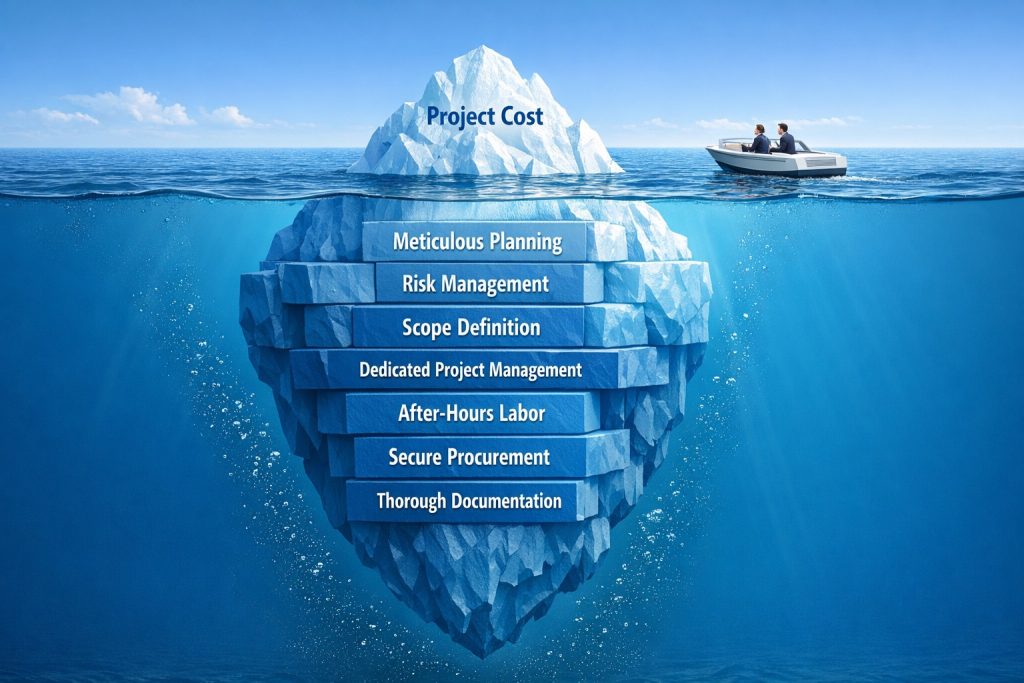
Deconstructing the Cost: The Anatomy of a Professional Project
When a client questions the cost, they often only see the final product. They don’t see the complex, interwoven processes required to get there. Here is what your project fee really covers:
1. The Discovery and Planning (Chapter 7):
This is the most critical and often most undervalued phase. A professional project doesn’t start with a technician showing up on-site. It starts with meticulous planning to:
- Understand the Business Goal: What is the client really trying to achieve?
- Map the Current State: We document every dependency, every potential conflict, and every risk before a single change is made.
- Design the Solution: Our experts architect a solution that aligns with their goals, not just a technical fix.
2. The Procurement and Logistics (Chapter 6):
You are not just ordering parts. You are managing a supply chain to ensure the right hardware and software arrive at the right time. This includes vendor vetting, lifecycle management, and handling all the administrative overhead.
3. The Execution and Communication (Chapter 4 & 7):
This is where the promise is delivered. The cost here covers not just the technical labor, but the structure that makes it effective:
- Dedicated Project Management: A single point of contact who provides proactive updates, manages timelines, and ensures you are never left wondering what is going on.
- Process Discipline: Our technicians follow documented, repeatable processes (SOPs) that minimize human error and ensure consistent, high-quality results.
- Minimizing Disruption: We schedule work to avoid interrupting your business operations, often working after hours or on weekends.
4. The Post-Project Handoff and Documentation (Chapter 5):
The project isn’t finished when the last server is installed. It’s finished when the client is empowered and the work is documented. This includes thorough documentation, seamless transition to support, and client training.
The Strategic Win: More Than Just a Finished Project
When you execute a project with this level of discipline and communication, you achieve more than just the technical objective. You achieve strategic wins that build lasting value:
- You Build Unshakeable Trust: By delivering on your promise, on time and on budget, you prove you are a reliable partner.
- You Demonstrate Your Value: The client doesn’t just see a bill; they see the professionalism, expertise, and peace of mind they paid for.
- You Create an Advocate: A client who has a great project experience becomes your best marketing asset, leading to referrals and long-term loyalty.
When you break it down this way, the conversation shifts from cost to value. You are not selling them a server; you are selling them a professionally managed, low-risk project that delivers a specific business outcome. That is a promise worth paying for.
Ready to Build Predictable, Profitable Projects?
Transforming your project work from a source of friction into a showcase of your value is a cornerstone of a mature MSP. It requires discipline, clear communication, and robust systems.
The book, “Rewired MSP: Mastery, Scalability & Performance,“ provides a complete playbook for this. From effective project management in Chapter 7 to documentation discipline in Chapter 5, it gives you the frameworks to deliver projects that build trust, delight clients, and drive profitability.
[Click Here to Get the Book and Master Your Project Process]
- Frequently Asked Questions (FAQ):
- Q: How can an MSP prevent scope creep in projects?
- A: Prevent scope creep by creating a detailed project plan that clearly defines what is in and out of scope. Also, establish a formal change order process to manage any new requests, ensuring that changes to scope, budget, and timeline are formally approved.
- Q: What is the best way to explain project costs to a client?
- A: The best way is to frame the cost as an investment in a specific business outcome. Explain that a fixed price also transfers the risk of cost overruns from the client to the MSP. Detail the professional process (Planning, Procurement, Execution, Handoff) that enables you to confidently assume that risk.
- Q: Who is responsible for cost overruns in a fixed-price MSP project?
- A: In a fixed-price project with a clearly defined scope, the MSP is responsible for cost overruns. The price reflects the MSP’s commitment to delivering the agreed-upon outcome for a set fee, taking on the risk of any unexpected challenges or extra hours required to complete the work.
- Q: How can an MSP prevent scope creep in projects?
