
The rise of AI agents like OpenClaw (formerly known as Clawdbot, Moltbot) is creating both excitement and serious concern in the business world. While the promise of autonomous task execution sounds appealing, the reality is far more complex and potentially dangerous for your business data and operations. If an employee has asked to use OpenClaw, or if you are considering deploying it yourself, you need to understand the risks before making that decision.
As I discuss in Chapter 11 of my book, Near Miss, the failure to establish proper AI governance and security guardrails is one of the most significant “near misses” facing modern businesses. OpenClaw is a perfect case study in why that guidance matters.
Start with the Outcome, Not the Tool
Before we dive into the technical risks of OpenClaw, we need to address a fundamental problem that plagues many technology decisions: deploying a tool simply because it is new and exciting.
The right reason to implement any new technology or strategy is almost never “because it’s new and shiny.” Yet, this is exactly how many AI tools end up in business environments. An employee reads about OpenClaw’s capabilities, gets excited about the possibilities, and wants to start using it immediately without asking a crucial question: What specific business outcome are we trying to achieve?
Starting without a predefined outcome is a recipe for wasted time, wasted productivity, and wasted money. You end up chasing the wrong tool, discovering too late that it does not actually solve your problem, or worse, that it creates new problems you did not anticipate. This approach turns technology adoption into an expensive experiment rather than a strategic investment.
Before OpenClaw or any AI tool touches your network, you need clear answers to these questions:
- What specific business problem are we trying to solve?
- What measurable outcome do we expect from this tool?
- How will we know if it is successful?
- What is the cost (in time, money, and risk) if this tool fails to deliver?
If you cannot answer these questions with clarity, you are not ready to deploy the tool. As I emphasize throughout Near Miss, technology should serve your business strategy, not the other way around. Do not let the allure of cutting-edge AI distract you from the disciplined thinking required to implement it safely and effectively.
What Is OpenClaw?
OpenClaw is an open-source, agentic AI framework that allows AI to perform tasks autonomously on your behalf. Unlike traditional AI tools that simply respond to prompts, OpenClaw is designed to take action: accessing websites, interacting with APIs, executing code, and making decisions without constant human oversight.
According to Forbes, OpenClaw represents a significant shift in how AI interacts with digital environments. While this autonomy can be powerful, it also introduces unprecedented security risks that most businesses are not prepared to manage.
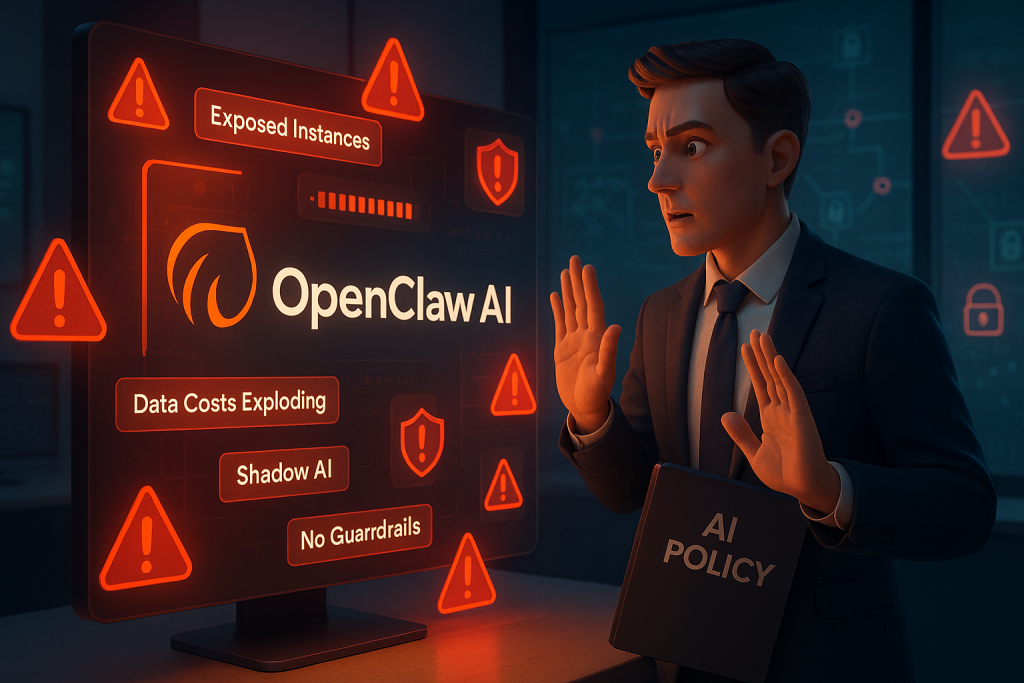
The Security Risks Are Real and Immediate
Before you allow OpenClaw anywhere near your business network, you need to understand what you are actually exposing yourself to. These are not theoretical concerns. They are active, documented threats.
1. Exposed Instances Everywhere
According to Cybersecurity News, thousands of OpenClaw instances have been found exposed online with little to no security configuration. Many of these deployments have default credentials, no authentication, and are openly accessible to anyone who knows where to look. If your organization deploys OpenClaw without proper security hardening, you could be creating an open door for attackers to access your network and data.
2. China Has Issued Official Warnings
Reuters reported that China’s cybersecurity authorities have issued formal warnings about OpenClaw, citing significant security vulnerabilities. When a nation-state cybersecurity agency issues a public warning about a specific technology, that should be a massive red flag for any business considering its deployment.
3. Personal AI Agents Are a Security Nightmare
As detailed by Cisco’s AI blog, agentic AI tools like OpenClaw fundamentally challenge traditional security models. These agents operate with broad permissions, can access multiple systems, and make autonomous decisions that may not align with your security policies. Traditional endpoint protection and firewalls are not designed to detect or prevent the kinds of actions an AI agent might take on your network.
4. VentureBeat’s CISO Guide Highlights the Danger
VentureBeat published a comprehensive CISO guide that breaks down the specific risks OpenClaw poses to enterprise environments. The guide emphasizes that agentic AI introduces attack surfaces that most security teams have never had to defend against, including prompt injection attacks, data exfiltration through legitimate-looking API calls, and the potential for an AI agent to be manipulated into executing malicious commands.
The Hidden Cost: Token Usage Can Explode Your Budget
Beyond the security risks, there is a financial trap many businesses fall into when deploying AI agents like OpenClaw. These tools typically operate on a token-based pricing model, where every API call, every prompt, and every action the agent takes consumes tokens that you pay for.
Unlike a simple chatbot where you control when and how often you interact, an agentic AI like OpenClaw can run continuously, making thousands of API calls without your direct oversight. A single misconfigured task or an agent stuck in a loop can burn through your token allocation in hours, resulting in unexpected bills that can reach hundreds or even thousands of dollars.
If you do not have strict usage limits, monitoring, and budget controls in place, you could face a financial surprise that makes any perceived productivity gain meaningless.
What Permissions and Guardrails Do You Need?
If, after understanding these risks, you still decide to explore OpenClaw in your business environment, you absolutely must implement robust security guardrails and policies. Drawing from the principles in Chapter 11 of Near Miss, here is what you need:
1. Establish a Formal AI Usage Policy
Before any AI agent is deployed, your organization needs a written, enforceable AI usage policy. This document should define:
- Which AI tools are approved for business use
- What data can and cannot be shared with AI systems
- Who has authority to deploy new AI tools
- Consequences for violating the policy
2. Implement Least Privilege Access
As discussed in Chapter 7 of Near Miss, granting users too many rights is a common vulnerability. An AI agent should operate with the minimum permissions necessary to perform its function. If OpenClaw does not need access to your financial systems, customer database, or email server, it should be blocked from those resources at the network and application level.
3. Isolate AI Agents in Segmented Networks
Do not allow OpenClaw or similar tools to run on the same network segment as your critical business systems. Use VLANs (as discussed in Chapter 5) to isolate AI agents and limit their ability to move laterally across your infrastructure if they are compromised.
4. Monitor and Log All AI Activity
Every action taken by an AI agent should be logged and monitored. Your IT provider should have visibility into what the agent is doing, what data it is accessing, and what external services it is connecting to. Without this visibility, you are flying blind.
5. Set Hard Limits on API Token Usage
Configure strict spending limits and usage quotas for any token-based AI service. Many platforms allow you to set daily or monthly caps. Use them. You should also receive alerts when usage approaches your threshold so you can investigate before costs spiral out of control.
6. Require Approval for Deployment
No employee should be able to deploy OpenClaw or any other AI agent without explicit approval from IT leadership. This prevents “shadow AI” from proliferating across your organization without oversight (a major theme in Chapter 11).
7. Conduct Regular Security Audits
Your IT provider should regularly audit any AI deployments to ensure configurations remain secure, permissions have not drifted, and the agent is still operating within its intended scope.
The “Rogue AI” Problem: Shadow IT on Steroids
One of the most dangerous scenarios is when an employee, excited by the potential of OpenClaw, deploys it on their own without informing IT. As I warn in Chapter 11, this “rogue AI” behavior is shadow IT on steroids. The employee might think they are boosting their productivity, but they are actually:
- Exposing company data to an unvetted third-party service
- Creating security vulnerabilities that your IT team cannot see or defend against
- Potentially violating compliance regulations if sensitive data is processed
- Racking up unexpected costs that will eventually land on the company’s bill
This is why clear policies, employee education, and proactive monitoring are so critical.
A Real-World Parallel: The “Free” AI Trap
As discussed extensively in Chapter 11, many businesses fall into the trap of using “free” AI tools. The old adage holds true: if you are not paying for the product, you are the product. OpenClaw is open-source, which means it can be deployed without a licensing fee, but that does not make it free. The cost comes in the form of:
- Security risks and potential breach costs
- Token usage fees for API calls
- IT staff time required to secure and monitor the deployment
- Potential loss of proprietary data if information is leaked
The right approach is to use enterprise-grade, paid AI solutions that come with proper data privacy controls, compliance guarantees, and vendor support. These solutions may cost more upfront, but they protect what matters most: your business data and reputation.
What Should You Do?
If you are a business owner or IT decision-maker, here are your immediate action steps:
- Define Your Business Outcome First: Before considering any AI tool, clearly articulate what problem you are solving and what success looks like. Do not chase tools just because they are new.
- Assess Current AI Usage: Find out if any employees are already using OpenClaw or similar tools without authorization.
- Implement an AI Policy: Use the guidance in Chapter 11 of Near Miss to draft a comprehensive AI usage policy.
- Educate Your Team: Train employees on the risks of shadow AI and the importance of getting IT approval before deploying new tools.
- Work with Your IT Provider: Ensure your provider understands agentic AI risks and has a plan to secure, monitor, and manage any approved deployments.
- Set Budget Controls: If you do deploy OpenClaw, configure hard spending limits to prevent runaway costs.
The promise of AI agents like OpenClaw is real, but so are the risks. Do not let excitement override security, strategic thinking, and financial prudence.
Frequently Asked Questions
Q: Is OpenClaw safe to use in a business environment?
A: OpenClaw can be used, but only with significant security hardening, strict access controls, network isolation, continuous monitoring, and a comprehensive AI usage policy. Most businesses lack the expertise to deploy it safely. Exposed instances and official warnings from cybersecurity agencies indicate that many deployments are dangerously insecure.
Q: Can OpenClaw access my company’s sensitive data?
A: If deployed with improper permissions, yes. An AI agent can access any data or system it is given credentials for. This is why least privilege access and network segmentation are critical. You must limit what OpenClaw can see and do.
Q: How much does OpenClaw cost to run?
A: OpenClaw itself is open-source, but running it requires API tokens for the underlying AI models it uses. Costs can vary widely depending on usage, but without proper monitoring and limits, token usage can spiral into hundreds or thousands of dollars per month. Always set hard spending caps.
Q: What happens if an employee deploys OpenClaw without IT approval?
A: This creates a “shadow AI” scenario where your IT team has no visibility or control. The employee could inadvertently expose company data, violate compliance regulations, rack up unexpected costs, and create security vulnerabilities. Your AI usage policy should clearly prohibit unauthorized deployments.
Q: Should I trust “free” AI tools like OpenClaw?
A: Be very cautious. As discussed in Chapter 11 of Near Miss, if you are not paying for a product, you are often the product. Free tools may use your data to train models, lack proper security controls, and offer no vendor support or compliance guarantees. Enterprise-grade, paid solutions are almost always safer for business use.
Q: What are the main security risks of agentic AI like OpenClaw?
A: The primary risks include exposed instances with weak authentication, autonomous actions that bypass traditional security controls, potential for prompt injection attacks, data exfiltration through legitimate-looking API calls, and the inability of traditional security tools to detect malicious AI behavior.
Q: How do I know if my IT provider is prepared to manage OpenClaw securely?
A: Ask them the questions from Chapter 11 of Near Miss. Do they have a clear AI governance framework? Can they monitor and log AI agent activity? Do they understand agentic AI risks? If they cannot answer these questions confidently, they are not ready to manage OpenClaw securely.
Q: Can I just block OpenClaw at the firewall?
A: Blocking outbound connections to OpenClaw services is one layer of defense, but it is not foolproof. Employees may find workarounds, and AI agents can operate through multiple APIs. You need a comprehensive approach that includes policies, monitoring, and education, not just firewall rules.
Q: What business outcome should I be solving for before I deploy OpenClaw?
A: This is the most important question. You should have a specific, measurable business problem that OpenClaw solves better than existing tools. Examples might include automating a repetitive, high-volume workflow that currently wastes staff time, or extracting insights from data sets that are too large for manual analysis. If you cannot clearly define the outcome and measure success, you are not ready to deploy the tool.
Related Resources:
- VentureBeat: OpenClaw Agentic AI Security Risk CISO Guide
- Reuters: China Warns of Security Risks Linked to OpenClaw
- Forbes: What Is OpenClaw and Why It Matters
- Cybersecurity News: OpenClaw AI Instances Exposed
- Cisco: Personal AI Agents Like OpenClaw Are a Security Nightmare
This post is adapted from core themes in the book Near Miss: Preventable IT Failures Threatening Your Business Security. Get your copy to learn how to safely integrate AI into your business operations without compromising security or budget.

One Comment