
So, You Hired a Hunter. Now What?
In our last post, we talked about a critical mistake many MSP owners make. They hire a generic “sales guy” and expect them to do it all. We broke down the three essential roles every MSP sales team needs for scalable growth: the Hunter (lead generator), the Closer (deal maker), and the Farmer (relationship nurturer).
Most owners are natural Closers, so their first strategic hire should be a Hunter to fill the top of the funnel.
So, you did it. You found a great Hunter, they’ve signed the offer letter, and they start in two weeks. Problem solved, right?
Not even close.
Hiring the right person for the right seat is just the first step. If you bring that talented Hunter into an environment with no process, no tools, and no clear definition of success, you are setting them up to fail. Before your new hire even walks in the door, you need a plan.
A Great Salesperson with a Bad System Will Lose to a Good Salesperson with a Great System.
Let’s be clear, your new sales hire cannot live inside your head. The intuition, relationships, and processes you have used as the owner cannot just be transferred through osmosis. You are not just hiring a person; you are building a function within your business. And that function needs structure to survive and thrive.
Success in sales is not about individual heroics. It is about a predictable, repeatable system. When you have a great system, you create a foundation that empowers your team to succeed consistently. Without one, you are just gambling on luck and personality. To make your new hire successful and to build a sales engine that truly scales, you need to build the infrastructure for them. This starts with three key areas: your CRM, your process, and your KPIs.
1. Choose Your CRM (Your Single Source of Truth)
A Customer Relationship Management (CRM) platform is non-negotiable. It is the central nervous system for your entire sales and marketing operation. But not all CRMs are created equal. You need to choose one that fits your company’s size, budget, and strategy.
Do not get dazzled by a million features you will never use. Ask these questions:
- Does it fit our budget? A CRM should make you money, not drain your resources.
- Is it easy to use? If it is too complex, your team will not use it. If they do not use it, it is worthless.
- Does it integrate with our other tools? It should seamlessly connect to your marketing automation, PSA, and quoting tools.
The CRM is where every lead, every conversation, and every activity lives. As we covered in Chapter 5 of Rewired MSP, if it is not documented, it did not happen. A well-managed CRM ensures that knowledge does not walk out the door when a salesperson does.
2. Map Your Process (The Lead-to-Client Journey)
Clients do not just magically appear. They are guided along a carefully planned journey. You need to build this journey before you ask someone to lead prospects through it.
A CRM is only as good as the process you build within it. Get your team together and map out every single step:
- Lead Capture: How do leads from your website, marketing, or referrals get into the CRM?
- Qualification: What criteria makes a lead a “qualified” opportunity?
- Nurturing: What happens to leads that are not ready to buy yet?
- Handoff: At what point does a lead move from Marketing to the Hunter? Or from the Hunter to the Closer?
- Closing: What are the steps from the first meeting to a signed contract?
This is not just a sales exercise. Your service and vCIO teams need to be part of this conversation to ensure the promises made during the sales journey can actually be delivered.
3. Define Your KPIs (Know What “Good” Looks Like)
How will you know if your new Hunter is succeeding? “Making calls” is not a result, it is an action. You need to define clear, measurable Key Performance Indicators (KPIs) from day one, so everyone knows exactly what is expected.
Good KPIs are specific and tied to outcomes. For a Hunter, this could include:
- Activities: Number of new conversations started per week.
- Milestones: Number of qualified first-time appointments booked per month.
- Results: Number of new opportunities created that move to the “proposal” stage, number that ultimately become clients, amount of new revenue that represents on a monthly or yearly basis.
These KPIs should not be a secret. They should be documented in a role-specific playbook, stored right in your secure documentation portal (you are doing that, right?). This playbook becomes the guide for their first 90 days and beyond.
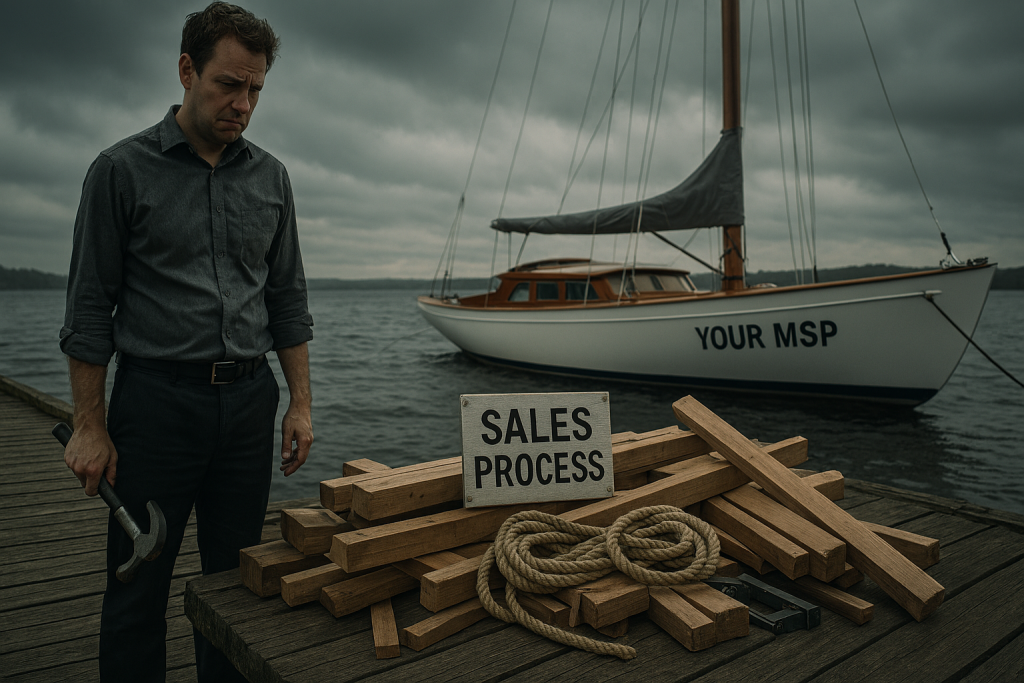
Don’t Hire Someone to Build the Ship. Hire Them to Sail It.
As the owner, it is your job to be the architect of the systems that drive growth. Your first sales hire is there to execute the plan, not to invent it from scratch. Asking a new salesperson to build your entire sales process is like hiring a world-class sailor and then asking them to build the boat, too. They may be talented, but you have put them in the wrong role and wasted their true skills.
This is a fundamental principle of scaling your MSP. Building repeatable, scalable systems is the leader’s responsibility. It is the stewardship you owe to your team and your company’s future. This is the work that transitions you from an owner-operator to a true visionary.
By establishing your CRM, mapping your sales process, and defining clear KPIs before your new hire starts, you give them the ultimate tool: a clear path to success. You hired them for their talent; now give them the playbook they need to win. This intentional, disciplined approach is the difference between constant firefighting and building a legacy of excellence.
This post covers just one piece of the puzzle. Building a scalable sales engine is part of a larger journey of rewiring your entire MSP for sustainable growth. From documenting processes to eliminating owner bottlenecks and fostering a culture of accountability, every system is connected.
The book, “Rewired MSP: Mastery, Scalability & Performance,“ is the comprehensive playbook that shows you how to connect all the pieces. It provides the frameworks you need to build the ship, so you can hire the right people to sail it.
[Click Here to Get the Book and Start Building Your Scalable MSP Today]
