
For many business owners, the IT infrastructure is out of sight and out of mind until something breaks. You scrutinize budgets, compare quotes, and look for efficiencies. It’s natural to see an aging server or an expiring firewall subscription and think, “It’s working fine for now. Let’s put off that expense.” This decision feels like a win for the bottom line.
In reality, you’ve just made a down payment on a much larger, hidden expense. This is technical debt.
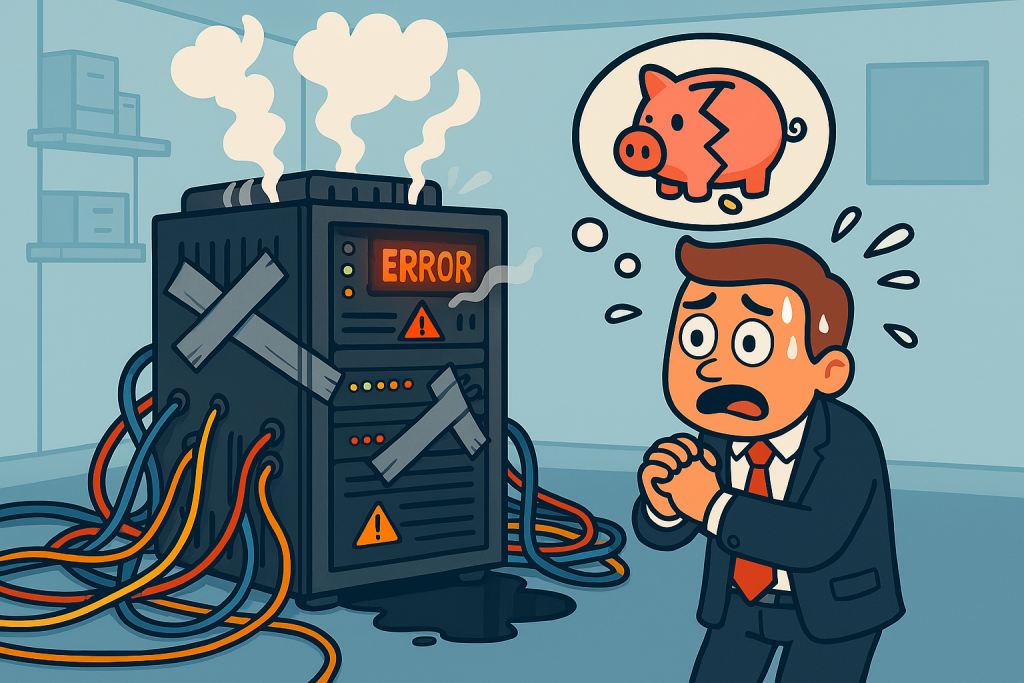
Technical debt is the implied cost of choosing an easy, short term solution instead of using a better, more strategic approach. Just like financial debt, it quietly accumulates interest over time. The longer you ignore it, the more it compounds. And make no mistake: technical debt always comes due, and it always charges compound interest.
As I explore throughout my book, Near Miss, relying on a “fix it when it breaks” mentality is not a strategy. It’s a danger to your business continuity. It is a crucial lesson that efficient and cheap are not at all the same thing.
How Technical Debt Builds Up in Your Business
Technical debt is not just a concept for software developers. It lives in every part of your IT infrastructure. It looks like:
- The “Slow Cooker” Firewall. You bought a great firewall three years ago, but the security subscription has expired. It’s still on the shelf, powered on, but it’s not receiving updates to protect against new threats. You have saved on renewal fees, but your network is now wide open.
- The Aging Server. The server running your most critical application is seven years old, long past its “End of Life” date from the manufacturer. It no longer gets security patches, and replacement parts are hard to find. It works today, but when it fails, it will take your entire operation down with it.
- Outdated Software. You avoid paying for software upgrades because the old version “still works.” Meanwhile, you are creating security holes and workflow inefficiencies.
In each case, you have accepted a “near miss” scenario to avoid a short term cost. But the cost of doing nothing is never zero.
The Real Costs: When Technical Debt Comes Due
Choosing the lowest bid or deferring maintenance might look good on a balance sheet for a quarter or two, but the long term bill is staggering. The “interest” on your technical debt is paid through very real costs to your bottom line.
- Crippling Downtime. When that unsupported server finally crashes, what is the cost of every hour your business is offline? Lost sales, missed deadlines, and unproductive staff add up incredibly fast. As I detail in Near Miss, even with perfect backups, they are useless if you have no working hardware to restore them to.
- Catastrophic Security Breaches. Outdated and unpatched systems are the number one target for cybercriminals. A single data breach can lead to devastating financial losses from fraud, compliance fines, and legal fees. This cost almost always dwarfs the price of the proactive maintenance that would have prevented it.
- Loss of Reputation and Client Trust. What is the cost of telling your clients that their sensitive information was stolen from your network? The damage to your brand and the loss of trust you worked so hard to build can be permanent and far more costly than any hardware upgrade.
- Wasted Productivity and Innovation. This is a huge, often invisible cost. Old, slow systems force your employees into inefficient workarounds. Time spent battling legacy technology or waiting for a slow computer is time not spent serving customers or innovating. This directly impacts your ROI.
As one business owner I worked with learned, choosing the cheapest IT bid can lead directly to a data breach that costs magnitudes more than the initial savings. Quality and security are not optional line items. They are foundational.
Finding the ROI: From Cost Center to Force Multiplier
The only way to escape the cycle of technical debt is to stop viewing IT as a burdensome cost center. Instead, see it for what it is: a force multiplier for your business.
Investing in an IT strategy that provides efficiencies and reduces the time your workforce is sitting around waiting for their equipment has a real, measurable ROI. The key is finding a provider that will collaborate with you to build out these strategies beyond just keeping things running day to day. A true partner helps you leverage technology to make your entire operation more profitable.
A proactive IT strategy, built with a competent Managed Service Provider, does not just prevent disasters; it drives growth. Modern, secure, and efficient systems empower your team to do their best work. When your technology aligns with your business goals, you move faster, work smarter, and build a more resilient and profitable organization.
Do not wait for a crisis to force your hand. The cost of doing nothing is a bill that always comes due. By investing strategically in your technology, you are not just managing expenses. You are securing your future.
This post is adapted from core themes in the book Near Miss: Preventable IT Failures Threatening Your Business Security. Get your copy to learn how to identify and eliminate the technical debt threatening your bottom line.

One Comment