
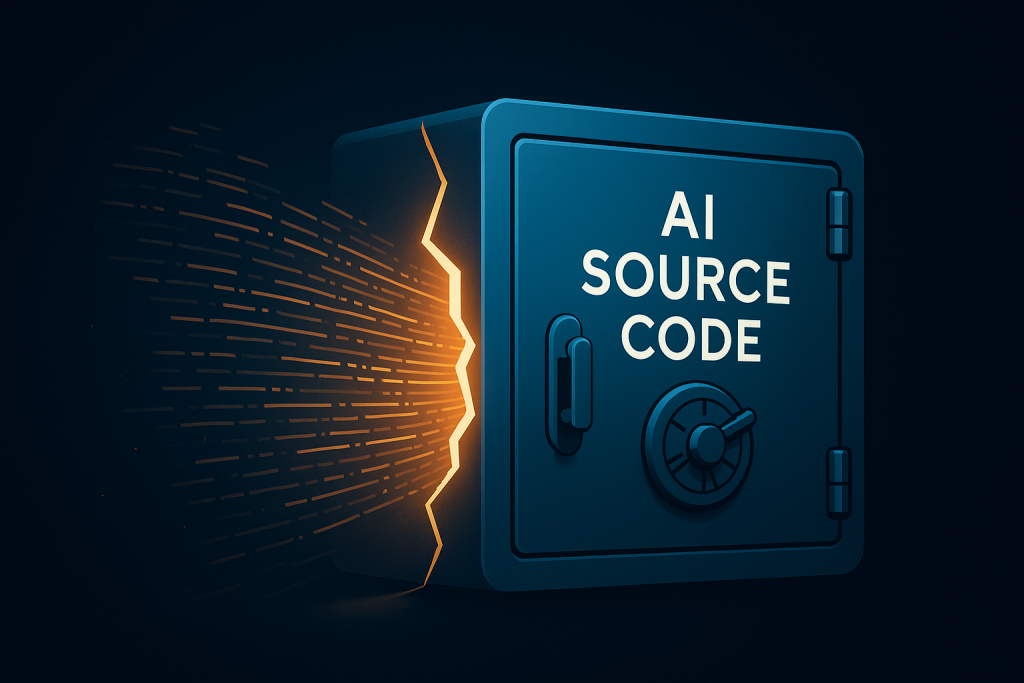
On March 31, 2026, one of the most well-funded, safety-focused AI companies in the world accidentally published 512,000 lines of its own proprietary source code to the public internet. Not because of a sophisticated cyberattack. Not because of a criminal insider. Because someone forgot to add a single line to a configuration file.
If Anthropic, a company valued at $380 billion and built on the promise of responsible AI, can expose its most sensitive technical secrets through a routine software update, every business owner using AI tools right now needs to ask a harder question than “which AI tool should we use?“
The right question is: what is your plan when something like this happens to your data?
Understanding the full scope of AI data leak business risk is no longer optional for companies of any size. This post breaks down exactly what happened, why it matters for your business even if you have never heard of Claude Code, and what you need to do right now to protect your organization.
What Actually Happened: The Anthropic Claude Code Leak Explained
Anthropic builds Claude, one of the leading AI models competing with ChatGPT and Google Gemini. Claude Code is their flagship AI coding tool, generating more than $2.5 billion in annualized revenue as of early 2026, according to CNBC reporting cited by QZ.
On March 31, a developer on Anthropic’s release team pushed an update to the public npm package for Claude Code. A debug configuration file was accidentally included in the package. That file contained a source map, a developer tool that references original uncompiled code. Inside that source map: 512,000 lines of original TypeScript code across approximately 1,900 files. All of it readable. All of it public. Available to anyone who ran a standard command to download the package.
According to Layer5’s analysis of the incident, a security researcher spotted the exposed code at 4:23 AM and posted a link on X. That post accumulated more than 21 million views within hours. A clean-room rewrite of the code hit 50,000 GitHub stars in approximately two hours, likely the fastest-growing repository in GitHub’s history. Anthropic subsequently issued copyright takedown requests against more than 8,000 copies and adaptations of the exposed code.
Notably, this was Anthropic’s second significant data exposure in five days. Just days earlier, a separate configuration error had exposed nearly 3,000 files from a publicly accessible data store on Anthropic’s website, including details about an unreleased model the company had been developing under the internal codename “Mythos.”
As Ars Technica reported in its detailed breakdown of the leak, the exposed code also revealed previously unknown features including a persistent autonomous background agent called KAIROS, an “Undercover Mode” designed to allow Anthropic employees to contribute to open-source repositories without disclosing that an AI made the contributions, and a mechanism called “AutoDream” that consolidates and rewrites the AI’s memory while the user is idle.
In short, a missing line in a configuration file handed competitors, hackers, and researchers the complete technical blueprint of a multi-billion dollar AI product.
Why This Matters Even If You Have Never Used Claude
You might be thinking: this is an AI company’s problem, not mine. My business does not write AI source code.
That thinking misses the real lesson of this incident entirely.
The Anthropic leak is not primarily a story about AI companies. It is a story about what happens when sensitive information enters an AI system without proper controls, and how fast that exposure can spiral once data escapes. The mechanisms behind this incident apply directly to how your employees, your automations, and your vendors handle your business data every day.
Consider three parallel risks this incident reveals for every business using AI tools.
Risk 1: Your Data Is One Configuration Error Away From Public Exposure
Anthropic did not intend to leak anything. No one was negligent in a malicious sense. A developer followed a normal process and made a single human error that no one caught before the package went live.
Your business faces the exact same risk every time an employee uses an AI tool connected to company data. Every integration, every automation, every API connection to an external AI service is a potential configuration error waiting to happen. Most of those errors are not caught by the tools themselves. They are caught by the people monitoring the systems, if anyone is monitoring them at all.
As I discuss in Chapter 11 of Near Miss, this is precisely the scenario that unfolds when businesses adopt AI tools without governance frameworks. The exposure is rarely dramatic. It is usually quiet, routine, and invisible until the damage is already done.
Risk 2: Leaked AI Architecture Enables Cloned Malicious Agents
This is the dimension of the Anthropic leak that most business coverage has underreported, and it is the one with the most direct security implications for your organization.
The exposed Claude Code source contained the complete technical architecture for how Anthropic’s AI agent connects to tools, manages memory, executes tasks, and interacts with external systems. According to the Economic Times analysis of the incident, security researchers reviewing the leak warned that the exposed code could allow technically sophisticated actors to extract additional internal information and to craft attacks targeting Claude Code’s permission system and bash validation logic.
More broadly, when the complete architecture of a leading AI agent becomes public, it dramatically lowers the barrier for building cloned, malicious versions of that agent. A bad actor with access to this blueprint can now build a tool that looks and behaves like a legitimate AI coding assistant but operates with entirely different instructions underneath. Specifically, it can be designed to:
- Harvest credentials and API keys from the development environments it accesses
- Exfiltrate source code and proprietary business logic from the codebases it is given access to
- Feed misleading or backdoored code suggestions to developers who trust it
- Operate in “Undercover Mode,” never identifying itself as an AI or as a potentially malicious tool
The Layer5 analysis noted that Claude Code had multiple known CVEs documented before the leak, including a code injection vulnerability rated CVSS 8.7 and an API key exfiltration vulnerability rated CVSS 5.3. With full source access now available, researchers and attackers can audit those systems at a fundamentally different level than was possible before.
This is not speculative. It is the documented response of the developer community in the hours immediately following the leak.
Risk 3: Shadow AI Makes Your Business the Next Leak
The third risk is the one closest to home for most small and mid-sized businesses, and it has nothing to do with Anthropic specifically.
Right now, employees at your company are almost certainly using AI tools you have not approved. According to the UpGuard State of Shadow AI Report from November 2025, more than 80 percent of workers use unapproved AI tools at work. The Sweep Big AI at Work Study from October 2025 found that 30 percent of employees have knowingly fed sensitive company information into public AI platforms.
Every time that happens, your business faces the same fundamental risk Anthropic faced. Your data enters a system where the configuration, the data handling policies, and the security controls are outside your control. Anthropic’s error was in their own infrastructure. Your employees’ errors happen in someone else’s infrastructure, under terms of service you have likely never read.
Furthermore, some of those employees are not just using AI chatbots. They are building their own AI automations. They are connecting company data to AI agents through Zapier, Make, or custom API integrations that have never been reviewed by your IT provider. Each of those connections is a potential configuration error. Each one operates in the background, often without anyone monitoring it.
The “Cloned Chatbot” Threat: What Your Business Needs to Understand
The Anthropic leak introduced a specific new threat category that every business owner should understand before deploying or allowing AI tools in their environment: the cloned or poisoned AI agent.
With the full architecture of a production AI agent now publicly documented, it has become significantly easier for malicious actors to build convincing fake versions. These are not theoretical. They are a predictable and documented consequence of major source code leaks in any software category.
In the context of AI agents, a cloned or poisoned agent can do the following:
Impersonate a trusted tool. An agent built on the leaked Claude Code architecture could present itself as a legitimate AI coding assistant or productivity tool while operating under malicious instructions that the end user never sees.
Harvest business data systematically. Agents with access to file systems, email, or databases do not need to steal data dramatically. They can read, summarize, and transmit information quietly through normal-looking API calls that are indistinguishable from legitimate tool behavior in most monitoring systems.
Inject compromised outputs. An agent helping a developer write code, draft documents, or generate reports can inject subtle errors, backdoors, or misleading information into the outputs it produces. Those outputs then enter your business processes without anyone questioning their origin.
Bypass traditional security controls. As Cisco’s AI security research has noted, AI agents making legitimate-looking API calls are virtually invisible to firewalls and endpoint protection tools designed to stop traditional malware. A cloned agent operates in this same blind spot.
The practical implication for your business is straightforward. Every AI tool your team uses needs to come from a vetted, enterprise-grade source with documented security controls, not from a GitHub repository, a free npm package, or an enthusiastic recommendation from someone’s LinkedIn feed.
What the Anthropic Leak Reveals About AI Governance Gaps
Beyond the immediate security implications, the Anthropic incident reveals something important about the state of AI governance even inside the most sophisticated AI organizations in the world.
Anthropic built a feature called Undercover Mode specifically to prevent internal information from leaking through open-source contributions. They invested in anti-distillation mechanisms to protect their intellectual property from competitors. They hired world-class security researchers and built robust safety frameworks.
And they still leaked 512,000 lines of proprietary source code because someone forgot to update a configuration file.
This is not a criticism of Anthropic. It is an illustration of a principle I discuss throughout Near Miss: the most sophisticated security frameworks in the world fail when basic operational processes break down. The firewall you never updated. The backup you never tested. The configuration file you forgot to update before the release.
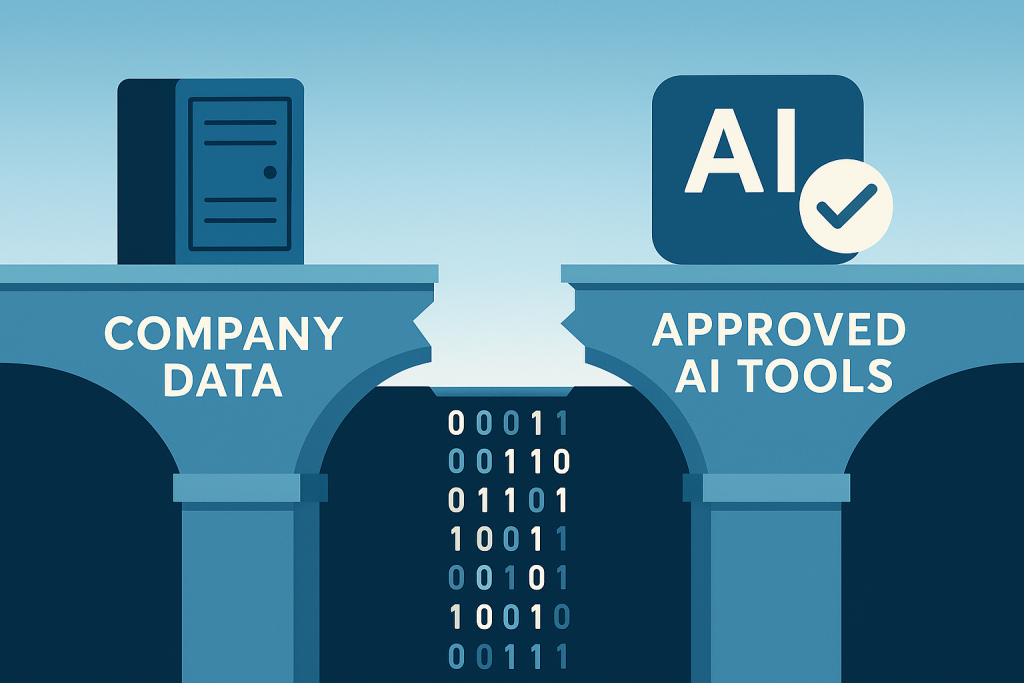
For small and mid-sized businesses, the lesson is proportional but equally important. You do not need enterprise-scale AI governance to protect your business. You need clear, enforced, basic policies that cover:
- Which AI tools are approved and which are not
- What data can and cannot be shared with any AI platform
- Who is responsible for reviewing and approving AI integrations before they connect to company data
- How AI-generated outputs are reviewed before they enter critical business processes
- What your incident response plan looks like if an AI tool exposes your data
Most small businesses have none of these policies in place today. That gap is exactly where the next data exposure will occur.
Five Questions to Ask Your IT Provider Right Now
The Anthropic incident is a useful forcing function for a conversation most business owners have been putting off. Take these questions to your IT provider this week.
1. Do we have a documented list of every AI tool our team is currently using?
If your provider cannot produce this list, shadow AI is already operating in your environment without oversight.
2. Do any of our approved AI tools or automations connect to company data through APIs or integrations that have never been formally reviewed?
Every unreviewed integration is a potential configuration error waiting to happen.
3. What is our process for vetting an AI tool before an employee is allowed to use it with company or client data?
If the answer is “we don’t have one,” that needs to change before the next tool gets deployed.
4. Do we have controls in place to detect when sensitive data is being transmitted to an external AI service?
DNS filtering and network monitoring can provide visibility into AI traffic. Most small businesses have neither configured for this purpose.
5. What is our incident response plan if an AI tool, whether ours or a vendor’s, exposes our business data?
The Anthropic incident resolved in hours for their own systems. The clones and mirrors of their leaked data will exist indefinitely. Your plan needs to account for both the immediate exposure and the long-term consequences.
What Responsible AI Adoption Actually Looks Like
None of this means your business should avoid AI. As I write in Chapter 11 of Near Miss, AI deployed within clear, responsible boundaries is a genuine force multiplier. It can automate documentation, generate executive summaries, streamline workflows, and surface insights that would be impossible to gather manually. The businesses that get this right will have a meaningful and compounding advantage over those that do not.
Getting it right, however, requires treating AI governance as a security discipline, not an afterthought.
Concretely, responsible AI adoption for a small or mid-sized business means:
- Using enterprise-grade tools with written data privacy guarantees and opt-out from model training built into the service agreement
- Maintaining a current, approved tool list that your IT provider manages and reviews as new tools emerge
- Training your team on what data can and cannot be shared with any AI platform, regardless of how reputable it appears
- Monitoring for shadow AI through network traffic analysis and DNS filtering
- Testing your AI automations the same way you test your backups: regularly, deliberately, and with documented results
- Building AI incident response into your broader security and business continuity planning
Your IT provider should be driving this conversation with you proactively. If they are not, the Anthropic incident gives you a concrete, timely reason to raise it yourself.
One Last Thought
The Anthropic leak was caused by a missing line in a configuration file. Two data exposures in five days from one of the best-funded, most safety-focused AI companies in the world.
Your business is not immune to the same category of failure. The difference is scale. Anthropic had 8,000 copies of their leaked code circulating within hours. A small business data leak through an unsanctioned AI tool may never make the news. But it will make your clients uncomfortable, your regulators interested, and your incident response team very busy.
The code can be refactored. The trust deficit cannot.
The AI data leak business risk your organization faces today is real, specific, and preventable. The businesses that treat it as a priority now are the ones that will not be explaining a data breach to their clients next year.
The Anthropic incident is one of eleven preventable failure patterns I cover in Near Miss: Preventable IT Failures Threatening Your Business Security. Each chapter ends with the exact questions you should bring to your IT provider.
Get your copy of Near Miss on Amazon today.
Frequently Asked Questions
Q: What is the AI data leak business risk and how does it affect small businesses?
A: AI data leak business risk refers to the exposure businesses face when sensitive information enters an AI system, whether through approved tools, shadow AI, or third-party integrations, and is subsequently exposed through a misconfiguration, breach, or unauthorized access. The Anthropic Claude Code leak demonstrates that even the most sophisticated AI organizations are vulnerable to this kind of exposure through routine human error. For small businesses, the same risk exists every time an employee uses an unapproved AI tool, connects a company data source to an AI automation, or relies on an AI platform whose data handling policies they have never reviewed.
Q: What exactly leaked in the Anthropic Claude Code incident?
A: On March 31, 2026, Anthropic accidentally published 512,000 lines of proprietary TypeScript source code for its Claude Code AI agent through a misconfigured npm package update. The leak exposed the complete architecture of how Claude Code orchestrates AI model behavior, including unreleased features, internal model codenames, security mechanisms, anti-competitive countermeasures, and previously unknown autonomous agent capabilities. No customer data or core AI model weights were exposed. However, the leaked architecture gave competitors, researchers, and potential attackers a detailed technical blueprint of one of the most commercially successful AI tools in the industry.
Q: How can a leaked AI architecture be used to create malicious AI agents?
A: When the full source code of a production AI agent becomes publicly available, it dramatically lowers the barrier to building convincing clone versions. A malicious actor can use that architecture to create an agent that looks and behaves like a legitimate AI tool while operating under hidden instructions designed to harvest credentials, exfiltrate business data, inject compromised code outputs, or conduct reconnaissance inside a company’s systems. These cloned agents are particularly dangerous because they operate through legitimate-looking API calls that most traditional security tools cannot distinguish from normal behavior.
Q: What is shadow AI and why does it increase my business’s exposure to data leaks?
A: Shadow AI refers to the unsanctioned use of AI tools by employees without IT oversight or approval. According to the 2025 UpGuard State of Shadow AI Report, more than 80 percent of workers use unapproved AI tools at work. When employees use these tools with company or client data, that data enters external AI systems under terms of service the business has never reviewed, with data handling practices it cannot control. Every shadow AI interaction is a potential data exposure event. The Anthropic incident illustrates that even legitimate, approved AI vendors can expose data through configuration errors. Shadow AI adds an additional and entirely unmonitored layer of that same risk.
Q: How is an AI automation or agent different from a standard chatbot in terms of data risk?
A: A standard AI chatbot responds to individual prompts and the interaction is limited to what the user manually types. An AI agent or automation operates autonomously, connecting to file systems, email accounts, databases, APIs, and other data sources without requiring a human to approve each individual action. This means an improperly configured agent can access and transmit far more data than any chatbot interaction, often without anyone noticing until a billing statement, a security audit, or an external incident draws attention to it.
Q: What should my IT provider be doing to protect my business from AI data leak risks?
A: Your IT provider should be actively monitoring for shadow AI traffic through DNS filtering and network analysis, maintaining a current list of all approved AI tools and integrations, reviewing any AI automation or agent before it connects to company data, establishing and enforcing an AI usage policy that your team understands, and building AI-specific incident response procedures into your broader security plan. If your provider has not raised AI governance proactively, the Anthropic incident provides a specific, timely reason to start that conversation today.
Q: How is the AI data leak business risk similar to traditional data breach risks?
A: The mechanisms are different but the consequences are identical. A traditional data breach involves unauthorized access to your systems by an external attacker. An AI data leak occurs when your data enters an AI system, whether intentionally or through shadow AI use, and is subsequently exposed through a vendor misconfiguration, a cloned agent, or a model training process that surfaces your inputs in responses to other users. Both result in the same downstream exposure: client confidentiality violations, regulatory penalties, reputational damage, and potential legal liability. The key difference is that AI data leaks are far harder to detect and are rarely recognized as breaches in the traditional sense until significant time has passed.
Q: Where can I learn more about the other IT failures that could be threatening my business?
A: Near Miss: Preventable IT Failures Threatening Your Business Security by Brent Lacy covers eleven of the most common and costly IT failures affecting small businesses today, including AI governance gaps, backup failures, firewall neglect, identity security risks, and shadow IT. Each chapter closes with specific questions to bring directly to your IT provider. Available now on Amazon. Get your copy here.
Related Resources
- QZ: Anthropic Accidentally Leaked Its Own Source Code for Claude Code
- Layer5: The Claude Code Source Leak: 512,000 Lines, a Missing .npmignore, and the Fastest-Growing Repo in GitHub History
- Ars Technica: Here’s What That Claude Code Source Leak Reveals About Anthropic’s Plans
- Economic Times: Why Is Anthropic Racing to Contain the Claude Code Leak
- UpGuard: The State of Shadow AI Report 2025
- Sweep: The Big AI at Work Study 2025
- Cisco: Personal AI Agents Are a Security Nightmare
- IBM Cost of a Data Breach Report 2024

One Comment